

Your report is done, but the reference list still looks wrong. IEEE wants initials before surnames, numbered brackets, abbreviated journal names and its own month style, and one slip can cost marks or send a paper back to you. This free IEEE citation generator builds each reference from the official IEEE rules, numbers your list for you, and gives you the matching in-text citation in seconds.
What Is an IEEE Citation Generator?
An IEEE citation generator is a free online tool that turns the details of a source into a correctly formatted IEEE reference. You paste a DOI, a link or an ISBN, or you type the details yourself. The tool then writes the numbered reference and the matching in-text citation, such as [1], following IEEE style.
Some people call it an IEEE reference generator, because it builds the whole reference list as well. IEEE stands for the Institute of Electrical and Electronics Engineers. Its referencing style is the standard for engineering, computer science and information technology papers. You will meet it in IEEE journals, IEEE conference papers, lab reports and many university theses.
Formatting by hand is slow because every source type has its own pattern. A journal article, a website and a patent all look different. The generator holds those patterns, so you only check the details.
How Do You Use This IEEE Citation Generator?
Paste a DOI, URL, ISBN or arXiv ID into the search box and press Cite. The tool finds the source, fills in the form and shows the reference. Check the fields, add anything missing, then click “Add to reference list”. Repeat for each source and copy the whole list when you finish.
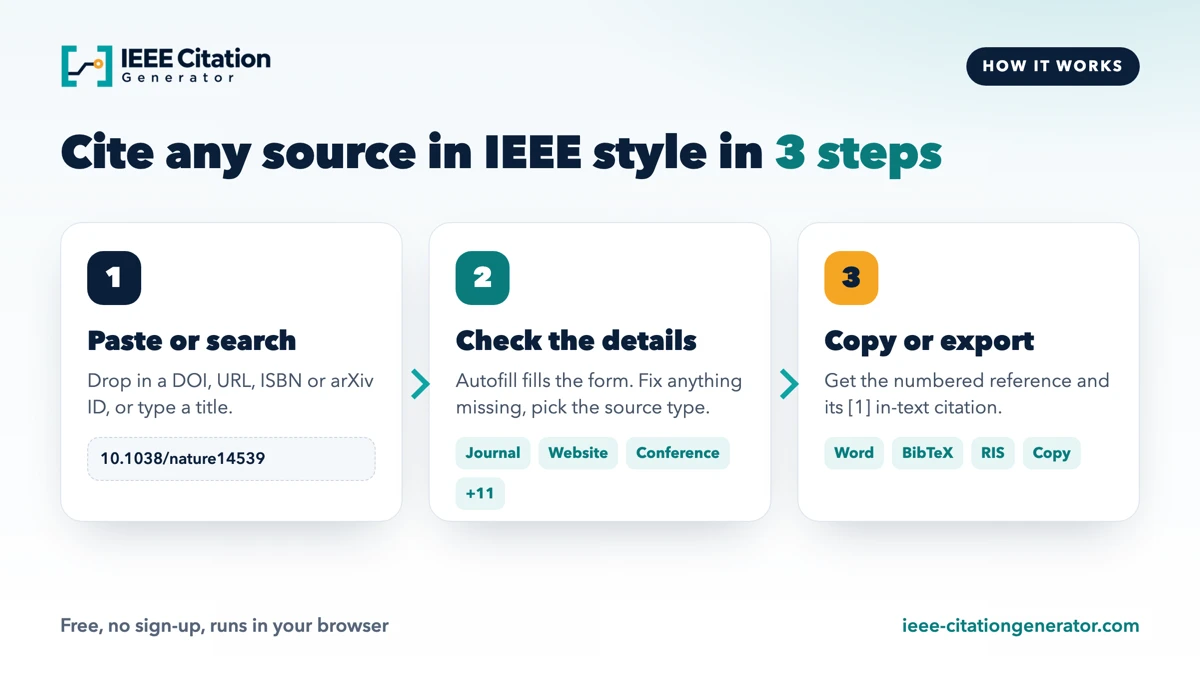
- Find the source. Paste an identifier, or search by title. Pick the right match from the results.
- Check the details. Autofill pulls data from public databases such as Crossref. Fix any wrong capital letters or missing page numbers.
- Pick the source type if it needs changing: journal article, conference paper, book, chapter, website, report, thesis, patent, standard, magazine, video, dataset, software or preprint.
- Add it to your list. The tool numbers it in the order you add it, which matches IEEE’s order-of-citation rule.
- Copy or export. Copy the list with italics intact, or download it as a Word file, a BibTeX file for LaTeX, or an RIS file for Zotero, Mendeley and EndNote.
Your list stays in your own browser. Close the tab, come back tomorrow, and your references are still there.
What Makes This IEEE Citation Generator Different?
This IEEE citation generator follows the current IEEE Reference Style Guide for Authors, covers 14 source types and needs no account. It abbreviates journal and conference names, uses IEEE’s month style, switches to “et al.” after six authors and exports straight to LaTeX. Many free tools stop at books, websites and journal articles.
Here is what you get on this page:
- Current rules. Formats match the current IEEE guide, including Jun., Jul. and Sep. as month abbreviations.
- Engineering sources. Conference papers, standards, patents, datasets, technical reports and arXiv preprints each have their own form.
- Smart abbreviations. “IEEE Transactions on Pattern Analysis and Machine Intelligence” becomes “IEEE Trans. Pattern Anal. Mach. Intell.” automatically, and you can switch it off.
- LaTeX-ready export. The BibTeX file works with the IEEEtran style, which most IEEE templates on Overleaf use.
- No sign-up, no paywall. Every feature on this page is free.
How Does IEEE Citation Style Work?
IEEE style is a numbered citation system. Each source gets a number in square brackets the first time you cite it, and that number stays with the source for the whole paper. The reference list at the end shows every source in number order, not in alphabetical order.
Learning how to cite in IEEE starts with three ideas, and the IEEE citation generator applies all of them for you:
- Numbers, not names. The reader sees [4] in your text and finds entry [4] in the list.
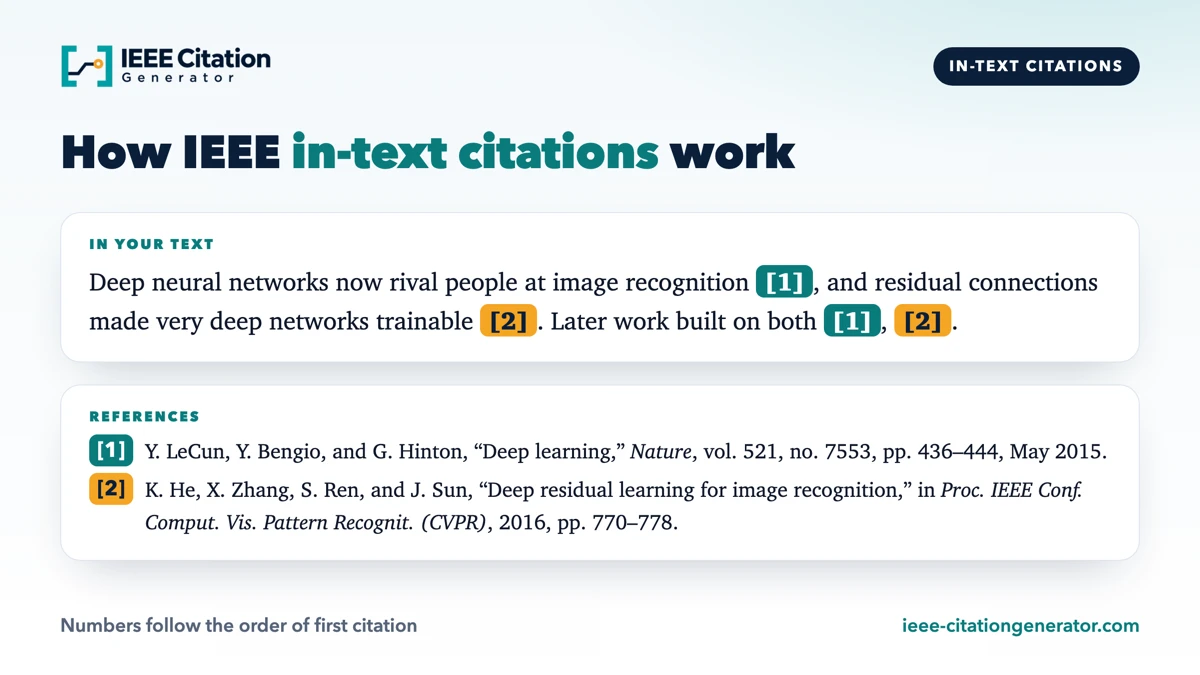
- Order of first citation. The first source you cite is [1], the second new source is [2], and so on.
- One number per source. The IEEE guide says each number belongs to exactly one reference. Citing a source again means reusing its first number, never “ibid.”
This system keeps technical writing compact. Long author-date strings would crowd equations and figure captions, so brackets work better in engineering papers.
How Do You Write IEEE In-Text Citations?
Put the reference number in square brackets on the same line as your text, inside the sentence’s punctuation. Write “as shown in [3].” with the period after the bracket. You can treat the bracket as a noun, as in “[3] proves this”, and you can add an author name before it: “Smith [3] found”.
| Situation | How to write it | Example |
|---|---|---|
| One source | Number in square brackets | …as reported in [2]. |
| Several sources | Each number in its own brackets, separated by commas | …in earlier studies [2], [5], [9]. |
| A run of sources | The 2025 IEEE guide writes each number out instead of using a dash | [1], [2], [3], [4], not [1]–[4] |
| A specific page or figure | Add the location after a comma inside the bracket | [3, p. 5], [3, Fig. 1], [3, eq. (2)] |
| Author named in the sentence | Name, then the number | Hinton [7] showed… |
| Three or more authors named in the sentence | First author plus “et al.” | He et al. [8] proposed… |
The IEEE citation generator shows the IEEE in-text citation under every reference preview. In your list, click the quote icon next to any entry to copy its number.
What Is the IEEE Reference Format for Each Source Type?
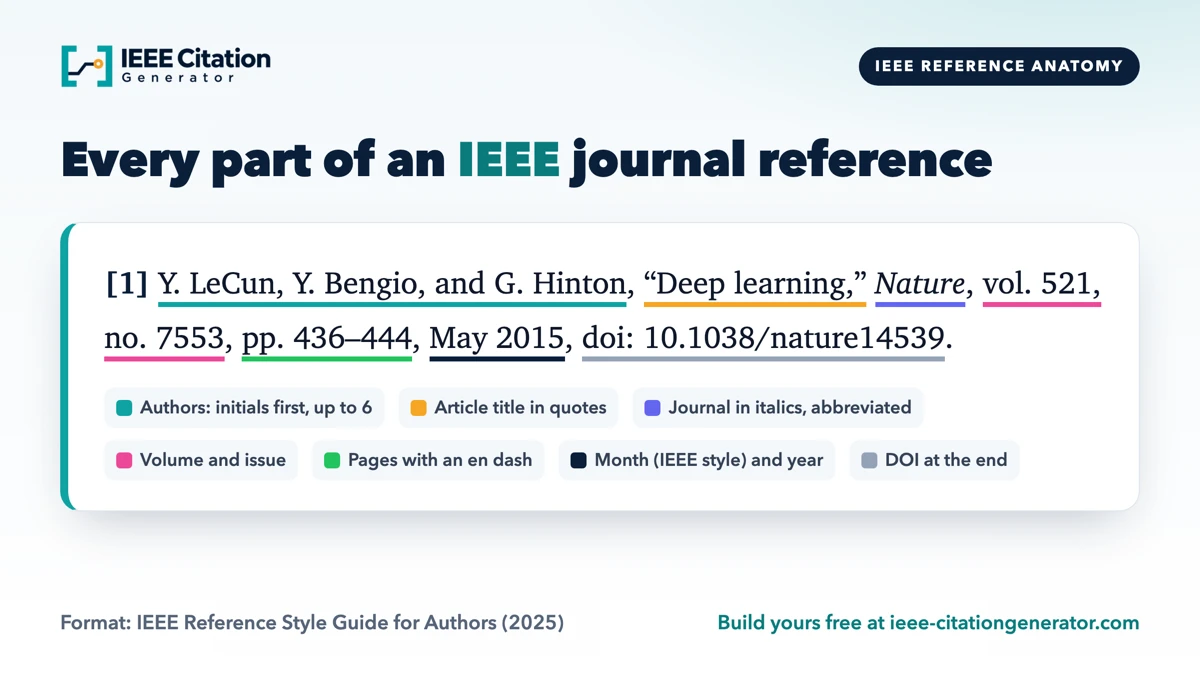
Every IEEE reference starts with the authors’ initials and surnames, then the title, then the publication details. Article and chapter titles go in quotation marks. Book, journal and conference names go in italics. The table below shows the pattern and a real example for the sources engineers cite most.
| Source type | IEEE pattern | Example |
|---|---|---|
| Journal article | A. Author, “Title,” Abbrev. Journal, vol. x, no. x, pp. xx–xx, Mon. year, doi: xxx. | Y. LeCun, Y. Bengio, and G. Hinton, “Deep learning,” Nature, vol. 521, no. 7553, pp. 436–444, May 2015, doi: 10.1038/nature14539. |
| Conference paper | A. Author, “Title,” in Abbrev. Name of Conf., year, pp. xx–xx. | K. He, X. Zhang, S. Ren, and J. Sun, “Deep residual learning for image recognition,” in Proc. IEEE Conf. Comput. Vis. Pattern Recognit. (CVPR), 2016, pp. 770–778. |
| Book | A. Author, Title, xth ed. City, Country: Publisher, year. | B. Klaus and P. Horn, Robot Vision. Cambridge, MA, USA: MIT Press, 1986. |
| Book chapter | A. Author, “Chapter,” in Book, X. Editor, Ed. City, Country: Publisher, year, pp. xx–xx. | G. O. Young, “Synthetic structure of industrial plastics,” in Plastics, 2nd ed., vol. 3, J. Peters, Ed. New York, NY, USA: McGraw-Hill, 1964, pp. 15–64. |
| Website | A. Author. “Page title.” Site name. Accessed: Mon. day, year. [Online]. Available: URL | Python Software Foundation. “The Python tutorial.” Python Documentation. Accessed: Nov. 20, 2026. [Online]. Available: https://docs.python.org/3/tutorial/ |
| Thesis | A. Author, “Title,” M.S. thesis, Abbrev. Dept., Abbrev. Univ., City, year. | C. E. Shannon, “A symbolic analysis of relay and switching circuits,” M.S. thesis, Dept. Elect. Eng., Mass. Inst. Technol., Cambridge, MA, USA, 1940. |
| Patent | A. Author, “Title,” Country Patent x xxx xxx, Mon. day, year. | J. S. Kilby, “Miniaturized electronic circuits,” U.S. Patent 3 138 743, Jun. 23, 1964. |
| Standard | Title of Standard, Standard number, date. | IEEE Standard for Floating-Point Arithmetic, IEEE Std 754-2019, 2019. |
| Technical report | A. Author, “Title,” Abbrev. Co., City, Country, Rep. xxx, year. | P. Mell and T. Grance, “The NIST definition of cloud computing,” Nat. Inst. Standards Technol., Gaithersburg, MD, USA, Special Publication 800-145, Sep. 2011. |
| arXiv preprint | A. Author, “Title,” year, arXiv:xxxx.xxxxx. | A. Vaswani et al., “Attention is all you need,” 2017, arXiv:1706.03762. |
| Online video | Creator. Title. (Release date). Accessed: date. [Online Video]. Available: URL | 3Blue1Brown. But what is a neural network? (Oct. 5, 2017). Accessed: Nov. 20, 2026. [Online Video]. Available: https://www.youtube.com/watch?v=aircAruvnKk |
Pick any of these types in the tool above and the form asks only for the fields that type needs. The grey example in the preview box shows the finished pattern before you type a word.
How Do You Format Author Names in IEEE Style?
IEEE writes the author’s initials first and the surname last: “Geoffrey Hinton” becomes “G. Hinton”. List up to six authors with commas and “and” before the last one. When a source has more than six authors, the IEEE guide lists only the first author followed by “et al.”
- Middle names become initials with a space: John Kevin Author is “J. K. Author”.
- Hyphenated first names keep the hyphen: Jean-Paul becomes “J.-P.”
- Two authors take “and” with no comma: “B. Klaus and P. Horn”.
- Three to six authors take a serial comma: “Y. LeCun, Y. Bengio, and G. Hinton”.
- Organizations appear in full where a person’s name would go, such as “Python Software Foundation”.
- Suffixes follow the surname after a comma: “A. B. Smith, Jr.”
Type full first names into the IEEE citation generator and it converts them to initials for you. Switch an author row to “Organization” for company or agency authors.
Which Abbreviations Does IEEE Use in References?
IEEE shortens months, journal names and common publishing words. Months become Jan., Feb., Mar., Apr., May, Jun., Jul., Aug., Sep., Oct., Nov. and Dec. Journal titles follow IEEE’s list of journal abbreviations, so “Journal” becomes “J.” and “Transactions” becomes “Trans.” One-word titles such as Nature stay whole.
| Word or element | IEEE abbreviation |
|---|---|
| Volume, number, pages | vol., no., pp. (p. for a single page) |
| Edition, editor, editors | ed., Ed., Eds. |
| Article number | Art. no. |
| Proceedings, conference, symposium | Proc., Conf., Symp. |
| International, national | Int., Nat. |
| Engineering, technology, communications | Eng., Technol., Commun. |
| Department, university, institute | Dept., Univ., Inst. |
The IEEE guide adds two handy rules. Words ending in “-ology” are cut to “-ol.”, so “Endocrinology” becomes “Endocrinol.” Compound words take the abbreviation of their last part, so “Bioengineering” becomes “Bioeng.” IEEE also publishes an official title list on the IEEE Author Center editorial style page, together with its free Reference Preparation Assistant for authors submitting to IEEE.
How Do You Cite DOIs, URLs and Online Sources in IEEE?
When a source has a DOI, end the IEEE reference with “doi:” and the number, then a period. When it has no DOI but lives online, add “[Online]. Available:” and the URL with no period after it. Websites, videos and software also need the date you accessed them.
A DOI (digital object identifier) is a permanent ID for a paper, so it beats a URL that may break. Crossref, the main DOI registration agency for journals, recommends showing DOIs as full links in its DOI display guidelines. IEEE references keep their own “doi: 10.xxxx” form, so the generator writes the DOI the IEEE way and strips any “https://doi.org/” you paste.
- Journal article with a DOI: no URL and no access date.
- Online-only report without a DOI: add “[Online]. Available:” and the link.
- Website: author or organization, page title in quotes, site name, “Accessed:” date, then the link.
How Should an IEEE Reference List Look?
Title the list “References” and place it at the end of your paper. List every source once, in the number order from your text, with its number in square brackets on the left. Use a hanging layout so the numbers stand out, and include only sources you actually cite.
Keep these checks in mind before you submit:
- Every bracket in the text has a matching entry, and every entry is cited at least once.
- Numbers run in order of first citation with no gaps.
- No entry combines two sources under one number.
- Journal and conference names are abbreviated the same way every time.
- Article titles use the same capitalization style throughout.
The generator handles the numbering and layout. Drag entries to reorder them if you change the order of your text, and the numbers update at once.
IEEE vs APA: What Is the Difference?
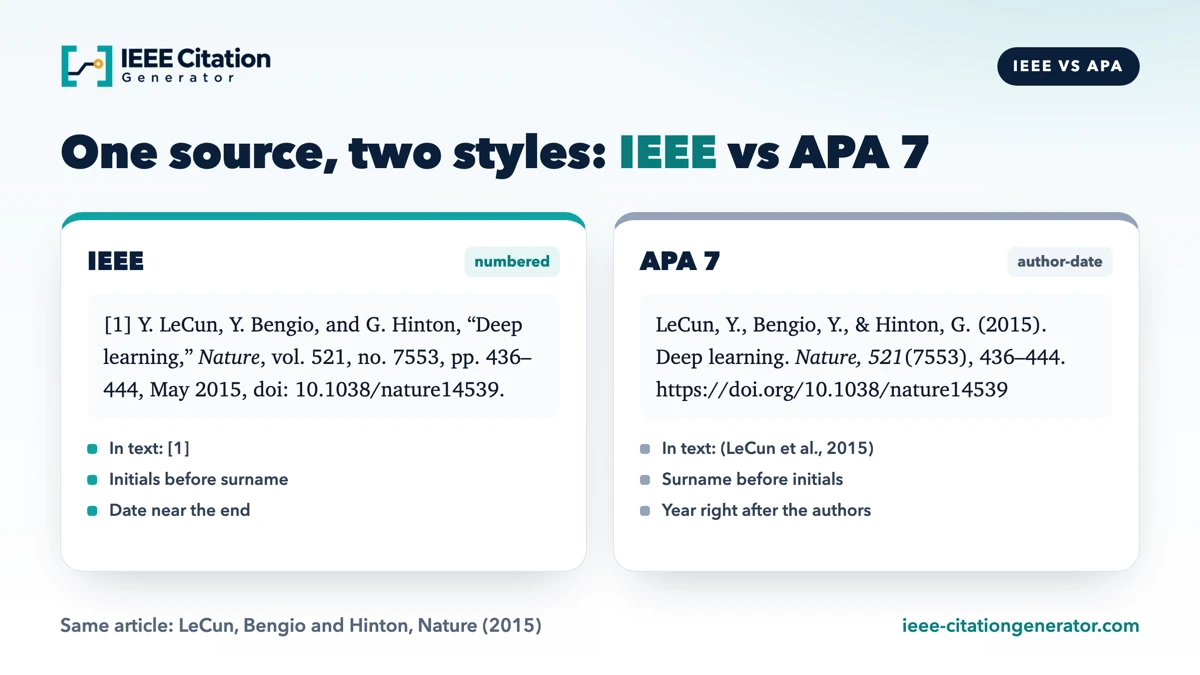
IEEE uses numbered square brackets and lists references in citation order. APA uses the author’s surname and year in parentheses, such as (Hinton, 2015), and lists references alphabetically. Engineering and computing courses favor IEEE, while psychology, education and many social sciences use APA.
| Feature | IEEE | APA 7 |
|---|---|---|
| In-text citation | [1] | (Author, year) |
| List order | Order of first citation | Alphabetical by author |
| Author names | Initials first: G. Hinton | Surname first: Hinton, G. |
| Date position | Near the end | Right after the authors |
| Journal names | Abbreviated | Written in full |
| List heading | References | References |
Check your course outline or the journal’s author instructions before you choose. If they name IEEE, stay with the tool on this page.
What Are the Most Common IEEE Citation Mistakes?
The mistakes that cost the most marks are full first names instead of initials, references sorted alphabetically, journal names left unabbreviated, missing page ranges and old month abbreviations such as “Sept.” Each one is easy to miss by hand, and the IEEE citation generator prevents all of them.
- Alphabetical lists. IEEE numbers sources by first citation, never by surname.
- Repeating a source with a new number. Reuse the first number every time.
- Using “pp.” for one page. A single page takes “p.”
- A hyphen in page ranges. IEEE uses an en dash: pp. 436–444.
- Listing all twelve authors. Over six authors means first author plus “et al.”
- Forgetting the access date on websites and online videos.
- Skipping the DOI when the article has one.
Who Uses IEEE Style?
Students and researchers in electrical engineering, electronics, computer science, software engineering, telecommunications and information technology use IEEE style most. IEEE requires it for its own journals, magazines and conference proceedings, and many universities set it for engineering lab reports, capstone projects and theses.
Many conferences outside IEEE also ask for numbered references in IEEE format, especially in robotics, signal processing and machine learning. If your template uses LaTeX, the IEEEtran BibTeX style on CTAN, the main archive for TeX packages, produces the same layout from a .bib file. Export your list as BibTeX here and drop it straight into your project.
Frequently Asked Questions About the IEEE Citation Generator
Is this IEEE citation generator free?
Yes. The IEEE citation generator is completely free, with no account, no trial and no limit on references. Every export, from Word to BibTeX, is free too.
How do I cite a website in IEEE format?
Write the author or organization, the page title in quotation marks, the website name, “Accessed:” with the date, then “[Online]. Available:” and the URL. Paste the link into the tool and it fills most of this in.
When does IEEE use “et al.”?
In the reference list, IEEE names up to six authors and switches to the first author plus “et al.” after that. In your sentences, use “et al.” when a source has three or more authors.
Do IEEE references need a DOI?
Include the DOI whenever the source has one. It goes at the end as “doi: 10.xxxx/xxxx.” and replaces the URL for journal articles and conference papers.
How do I cite the same source twice in IEEE?
Use the number it received the first time. IEEE gives each source one number for the whole paper, so the second citation of source [3] is still [3].
Can I export IEEE references to Word or LaTeX?
Yes. Copy the list with formatting into Word or Google Docs, download a .doc file, or export BibTeX for LaTeX and Overleaf. RIS export works with Zotero, Mendeley and EndNote.
Start Your IEEE Reference List Now
Correct references show care, and IEEE rewards that care with cleaner reviews and better marks. Scroll back to the top, paste your first DOI or link into the IEEE citation generator, and build a numbered, export-ready reference list before your coffee cools. Bookmark this page so your list is waiting next time.
Written by Sara Whitfield, guides editor at IEEE Citation Generator. Sources: IEEE Reference Style Guide for Authors (IEEE Publication Operations, current version), Crossref DOI display guidelines, and the IEEEtran package documentation on CTAN.